

If I had a dollar for every time I have been asked about who pays for home care services, I would be able to comfortably feed my Scooters Coffee addiction.
Most of the time when I am asked this question, it is by the children of a potential client who have, like most Americans, assumed that Medicare is the pot of gold that will cover all of your health expenses when you hit a certain age. The conversation usually goes like this:
Client’s Son: “Mom has Medicare, so this should be covered, right?”
Me: “Unfortunately, Medicare doesn’t pay for personal home care services. Does your mom have Medicaid or Medicaid Waiver?”
Client’s Son: “Yes! She has Medicare.”
Me: [palm to forehead] “I wish Medicare paid for home care, but it doesn’t”.
Client’s Son: “Her Medicare Advantage Plan pays for home care services though, right?”
I don’t post this to poke fun of “client’s son”, because it isn’t his fault. Financial literacy is not something that most of us get a lot of formal education with, and more often than not, the only time you are going to find out exactly what Medicare and Medicaid are is when you finally hit that golden age where you can apply for Medicare and you have a Medicare professional walk you through your options. Disclaimer: I am not an insurance or health plan professional and this information is not to be used as advice. Contact your own insurance carrier for specific plan details.
Did you read that disclaimer? Thank you, now let’s move on to the BASIC differences between Medicaid and Medicare. This image below, courtesy of a UHC blog (click link to read), shows the main difference between Medicare and Medicaid.
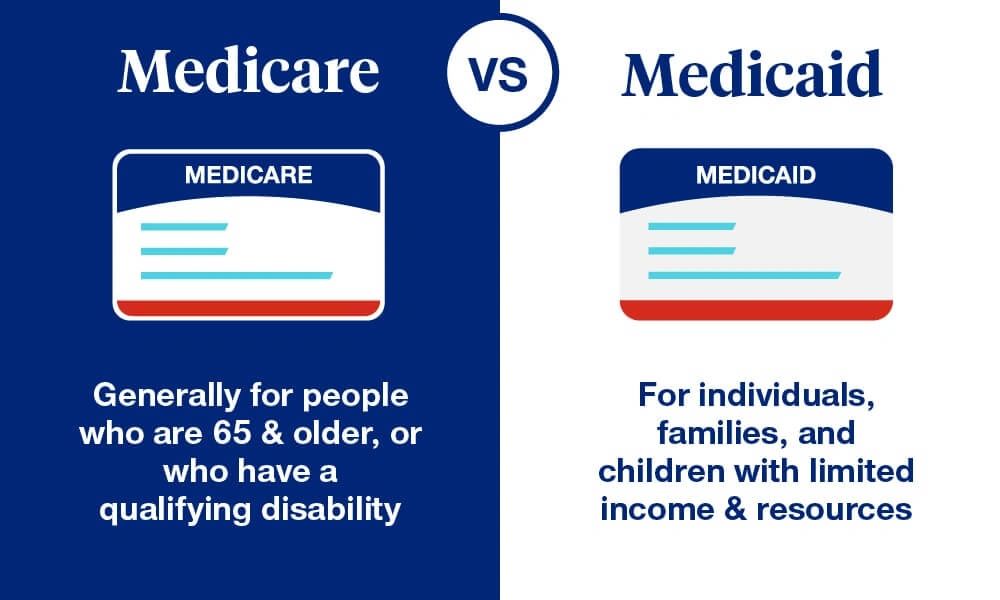
As you can see, Medicare is for individuals 65 & older or who have a qualifying disability, while Medicaid is for individuals, families, and children with limited income and resources. Generally, Medicare pays for your hospital visits, doctors visits, hospice care, home health nursing/rehab, and short term skilled nursing stays post-hospitalization. When and older adult has Medicaid, they can apply for Medicaid Waiver (I know I’m really muddying the water here). Medicaid Waiver is a program for low-income adults who meet the physical requirements (Need help with a specific number of their activities of daily living), and instead of going to an assisted living or nursing facility, they have been approved to get in-home non-medical care (i.e. caregivers) to come to their home for a pre-approved number of hours and Medicaid Waiver pays the bill. Sometimes people will have a certain copay (called a share of cost) that they have to pay before Medicaid Waiver pays their portion, but that’s getting in the weeds a bit.
So, how much does your Medicare card get you in terms of non-medical home care/ caregivers? Zilch. Nada. Nothing. At least for now. There is talk of legislation that would add in-home care as a Medicare benefit, but nothing (to my knowledge) is official at this time.
What about my supplemental insurance? Do they pay? Not in my experience. I have not seen a supplemental insurance plan pay for non-medical in home care services. Not to say there might be one out there, but it isn’t common.
You’re telling me no insurance pays for non-medical home care unless I have Medicaid Waiver? There is one other type of insurance that my company (and others) accept, and that is Long Term Care Insurance (with a home care benefit). So if you or your loved one purchased an LTC insurance plan, find it and review it to see what the benefit is for in home care. I have seen policies that pay $150 per day and some that cover the entire amount. It really depends on the plan.
If you don’t have LTC Insurance and you don’t have Medicaid Waiver, then who pays? Unfortunately, the way most people pay for home care is privately with their hard-earned money. No, it isn’t the way most of us imagine spending our savings before we die, but that is the way it is. I have a saying that I tell my client’s and their families, “The freedom of staying at home often comes at the cost of in home caregivers”.
Not everyone can afford in-home care. Many families rely on complex schedules of family members taking turns, and that is okay, as long as there is a big enough support system to make it sustainable. The Home Care industry is a booming industry and I have seen prices rise from an average of $27 per hour to an average of $33 per hour (per my own research) in Omaha in just my first 19 months of business. Many factors, including the rising demand for higher wages for caregivers and ever increasing tech expenses required for timekeeping, documentation, and billing are just a few of the reasons we will continue to see the price of home care rise.
After this Debbie-Downer of a blog post, I’m sure you are wondering what the “average people” are supposed to do. I wonder that all the time. When I see the costs of home care, nursing home stays, assisted living, and the aging process in general, I really don’t know what the middle-class can financially survive. I hope that this blog isn’t finding you too late and that you will start planning now for your own “golden years”. If you are like me and think that the system isn’t working for the middle-class, write your law makers and demand change.
Thank you for reading, and I hope it helped!
-Kayla Nelson, RN, CHPN